
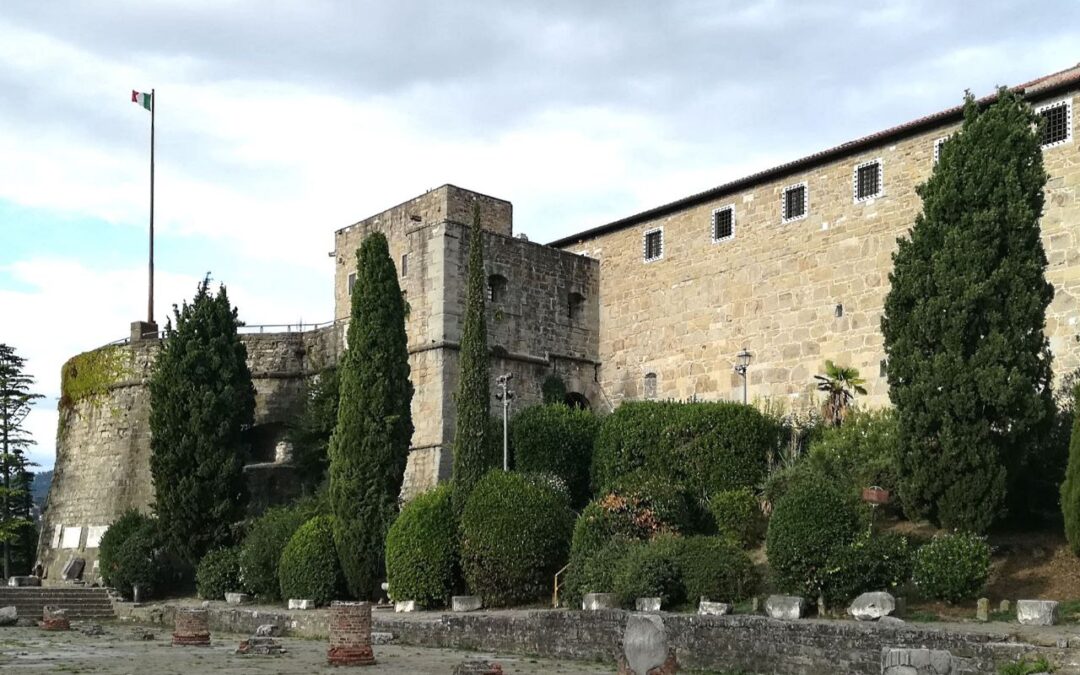
At the origins of Trieste: the first fortifications on the San Giusto hill
In the heart of the city of Trieste, the Colle di San Giusto stands like a silent custodian of an ancient history, which has its roots in much more remote periods than you can imagine. It is precisely on this natural relief, that the gulf dominates and controls the access routes from the mainland, that the first urban nucleus from which the current city will develop will be born.
An ancient settlement
The first traces of human presence on the San Giusto hill date back to the protohistoric age, probably around the second millennium BC. In this period, populations of pre -industry and subsequently the Castellieri (a civilization of the Bronze Age typical of Istria and Venezia Giulia) began to exploit the natural characteristics of the hill to build their fortified villages. The hill offered a strategic position: easily defensible, with a wide view of the sea and inland.
It was precisely the Castellieri civilization that built the first dry stone fortifications, circular defensive structures that protected the homes and delimited the sacred and political space of the community. These walls, often powerful, are among the oldest testimonies of the urban organization in the Trieste area.
Romanization and development of the city
In the third century BC, with the expansion of the Roman Republic to the north-east, Trieste (at the time Tergeste) entered the Roman orbit. The name itself, “tergeeste”, probably derives from the suffix -este (typical of carnary or Venetian locations) and “terg-“, which could be a reference to the widespread or terga, that is, cultivated fields, or could derive from an Indo -European root linked to the concept of home.
It was Julius Caesar who promoted the Romanization of Tergeste, which became Latin colony and subsequently municipalities. The Colle di San Giusto maintained a central role also in the Roman era: public buildings, temples and perhaps a first castrum, a military camp, which used the high position for control of the area were arising there.
The cult and continuity of the hill
During the Roman Empire, temples dedicated to Roman deities were built on the hill, including probably Jupiter and Minerva. Rests of columns, capitals and mosaics still visible now near the Cathedral testify to the architectural wealth of this period. With the advent of Christianity, the temples were gradually replaced by Christian religious buildings. The ruins were reused to build the first early Christian basilicas and, centuries later, the current Cathedral of San Giusto.
An identity symbol
The Colle di San Giusto has therefore represented the spiritual, military and political heart of Trieste for centuries. From the civilization of the Castellieri to the Romans, from the Middle Ages with the construction of the castle to the modern age, the hill has always been a point of reference for those who lived and defended the city.
Today, walking within the walls of the castle, the Roman remains and the cathedral, the millennial stratification of the history of Trieste clearly perceives: a city born from a hill, grown through peoples, cultures and civilizations that have left an indelible mark in its identity.
Massimo Battistutta
Culture and Tourism